

Decoration method
Custom screen printing, puff print and high-density print
Custom screen printing pushes ink through a fine mesh screen onto the garment, one screen for each color. It gives solid, opaque color on tees, hoodies, fleece and warm-ups, and with puff or high-density ink it builds a raised print. We screen print in house on garments we make for distributors, decorators and private-label brands, from 12 pieces per style, with each design quoted.
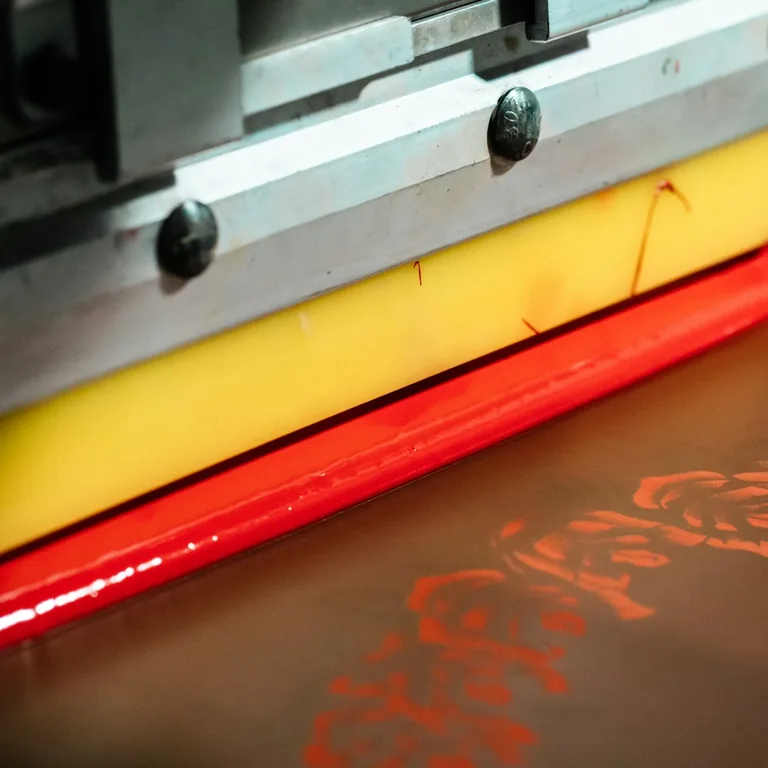
01How custom screen printing works
Your artwork is separated into its spot colors. Each color is exposed onto its own screen, and the screens print one after another, lined up so the colors register. Each layer is cured with heat so the ink bonds and stays flexible.
Because each color has its own screen, the setup is the same whether you print 12 pieces or 500. That makes screen printing strongest when many pieces share one design in a few colors.
02Plastisol and water-based ink
Plastisol ink sits on top of the fabric. It is opaque, bright on dark garments and works on cotton, blends and polyester, which makes it the usual choice for team fanwear.
Water-based ink soaks into the fibers for a much softer feel, best on light cotton. Discharge ink removes the dye from dyed cotton and replaces it with color, so the print has almost no feel; it does not work on polyester. Metallic, glitter and reflective inks are available for staff wear and special runs.
03Puff print
Puff print uses an ink with an additive that expands when it is cured, leaving a soft, rounded, raised print. It suits bold logos, block lettering and retro fanwear on hoodies and tees. Fine lines and small gaps close up as the ink rises, so artwork needs simple, thick shapes.
04High-density print
High-density print is built from thick layers of ink through a heavy stencil, which gives a sharp-edged, raised print rather than the rounded puff look. It is used for numbers, bold logos and structured graphics, and works best on cotton and cotton blends.
05Best garments and fabrics for screen printing
On dyed polyester, heat can pull the fabric dye up into a light ink. We use low-bleed ink and test the garment color first, and on stretch compression fabric we suggest sublimation or a stretch transfer instead.
- Cotton and cotton-blend tees, long sleeves and crewnecks
- Hoodies, sweatpants and fleece warm-ups
- Polyester practice shirts and shooting shirts, with low-bleed ink
- Bags and flat accessories with a smooth print surface
06Durability and care
A properly cured plastisol print lasts for the life of most fanwear. Wash cold and inside out, tumble dry low and do not iron the print. Water-based and discharge prints fade gently with washing, which is part of their soft, worn-in look.
07Art requirements for screen printing
Send vector artwork (AI, EPS, PDF or SVG) with each ink color as a PMS reference and the print size for each location. Gradients and photos are printed as halftone dots, so tell us if your design has them. Very thin lines and small type may not hold in puff or high-density ink.
08How screen printing is quoted
The blank garment is priced on our five quantity tiers. Screen printing is quoted on top, by the number of colors (screens), the number of print locations, the size of each print and any special ink such as puff, high-density or metallic. The cost per piece drops as the quantity grows because the screens are shared across the run.
We send a proof of the design, ink colors and placement for your approval before bulk production.
Q&AQuestions buyers ask
Is screen printing worth it for 12 pieces?
It can be for a one or two color design. For a small run with many colors, DTF often costs less per piece because there are no screens to set up, and we can quote both side by side.
Can you screen print on polyester jerseys?
Yes, with low-bleed plastisol ink, after we test the garment color. For full-color designs on polyester, sublimation usually gives a better result.
What is the difference between puff print and high-density print?
Puff ink expands during curing into a soft, rounded raised print. High-density ink is laid down thick through a heavy stencil and gives a sharper, flat-topped edge.
Can screen printing do individual player names and numbers?
Screen printing suits one design repeated across the run. Individual names and numbers are usually added with heat-transfer vinyl or DTF on the same garment.
Why does each ink color change the price?
Every color needs its own screen, setup and print pass. Reducing a design from five colors to three, or printing one color on a contrast garment, is the most direct way to lower the decoration cost.